Guides
How to pay with VietQR in Vietnam without a local bank account
Learn how VietQR works, why foreigners can get blocked, and how cash, cards, wallets, and ADAPAY fit into Vietnam payments without a local bank account.







Summarize content with
Open this guide in your preferred assistant and keep the payment decisions close.
 ChatGPT
 Perplexity
 Grok
Grok Gemini
What this guide solves
VietQR is one of the clearest examples of Vietnam’s payment culture. The QR code is visible in cafes, clinics, local shops, apartments, and food places. But for a foreigner without a Vietnamese bank account, seeing the code and paying the code are two different things.
This guide explains how VietQR works, where foreigners get stuck, and how ADAPAY fits for crypto-funded travelers and Russian expats.
Quick answer
You can live in Vietnam without a local bank account, but you need a payment stack. VietQR is common, but direct access usually depends on a Vietnamese banking or wallet route. Foreign cards work in formal places. Cash remains useful. ADAPAY is designed for supported local QR-style payments funded from wallet balance.
Why VietQR matters
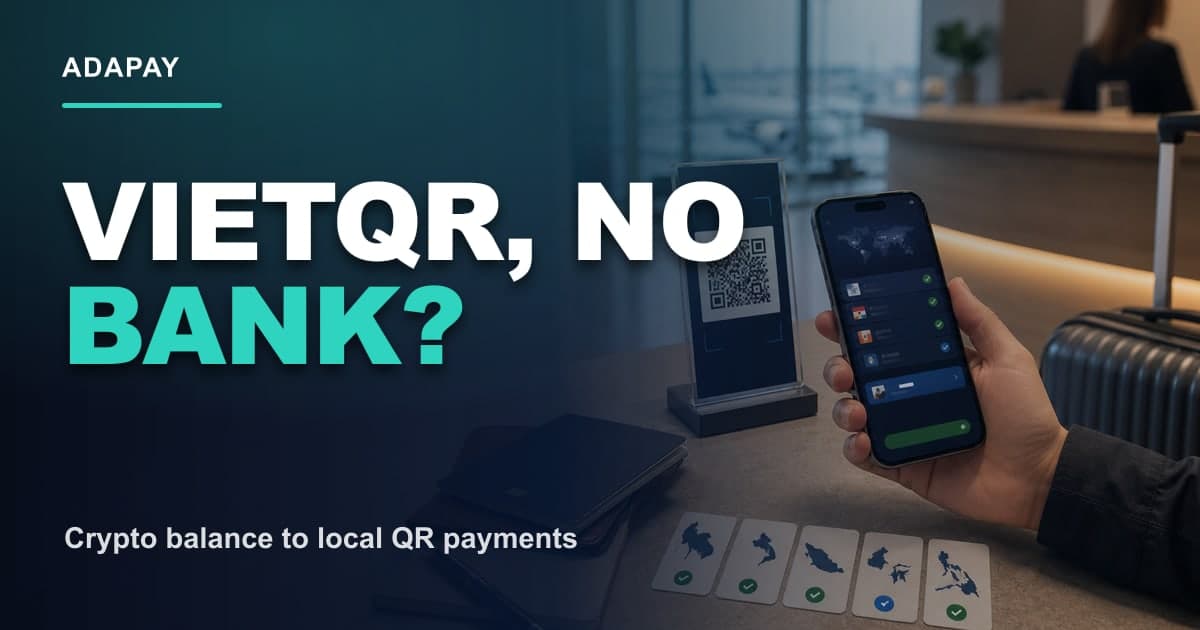
VietQR lets merchants present bank payment details as a scan. For local users, this removes typing account numbers and speeds up transfers. For merchants, it is cheap and familiar. For foreigners, the challenge is that a foreign bank app usually cannot simply scan and settle through Vietnam’s domestic banking rail.
That is why the most modern-looking payment method can feel inaccessible to a newcomer.
Options without a local bank
| Route | Works best for | Limitation |
|---|---|---|
| Cash | Markets, small vendors, backup | ATM fees and safety friction |
| Foreign card | Hotels, chains, supermarkets | Many small merchants do not use card terminals |
| Local wallet | Some app and wallet payments | Verification and funding can be difficult |
| Friend or landlord transfer | Occasional help | Not scalable or private |
| ADAPAY | Supported QR-style payments from crypto | Check coverage and limits first |
How to avoid payment stress
Before going cash-light in Vietnam, test your route in a low-pressure situation. Try a cafe or small shop before using the same method for rent, clinics, or services. Always verify the merchant name. Keep screenshots for payments that may need proof. Carry enough cash for one ride, one meal, and one phone-data failure.
For Russian expats and crypto holders, avoid building daily life around emergency P2P. It works until it interrupts the exact moment you wanted to be living normally.
Where ADAPAY fits
ADAPAY is built for the gap between crypto liquidity and local payment expectation. The merchant does not need to understand your wallet. You need a supported route that turns wallet balance into the local QR-style payment they expect.
In Vietnam, that means thinking less about "spending crypto" and more about "paying the local way from the balance I already have."
Final take
VietQR is not the problem. Access is the problem. If you do not have a Vietnamese bank account, prepare cash and card backups, learn local QR behavior, and use ADAPAY where supported to make crypto-funded local payments practical.
Practical checklist
Before relying on this route in Vietnam, test it while the stakes are low. Try one small payment, verify the merchant name, confirm the currency, and save the confirmation screen. If the payment route depends on wallet balance, prepare that balance before you are standing at the counter.
For foreigners in vietnam, the best setup is boring in the best way: one local payment route that works, one card for formal merchants, enough cash for one bad-data moment, and a clear record for anything larger than a meal.
Common mistakes to avoid
- Assuming a visible QR code means every foreign app can pay it.
- Treating P2P as a checkout method instead of a planned liquidity tool.
- Moving tiny on-chain amounts repeatedly instead of preparing a spendable balance.
- Forgetting that rent, deposits, clinics, and repairs need proof.
- Going fully cashless before testing the local rail in a calm moment.
ADAPAY route in one sentence
Use ADAPAY where supported when your money starts in a crypto wallet but the real-world payment request is local, immediate, and QR-shaped.
Informational content only
This resource is general information, not financial, legal, tax, or investment advice. Local payment access, coverage, fees, and eligibility can change; verify terms with the relevant provider before relying on any route. ADAPAY's public financial service is not live.
Sources
These public references provide context for this guide and may be updated by the relevant organizations.