QR payment explainers
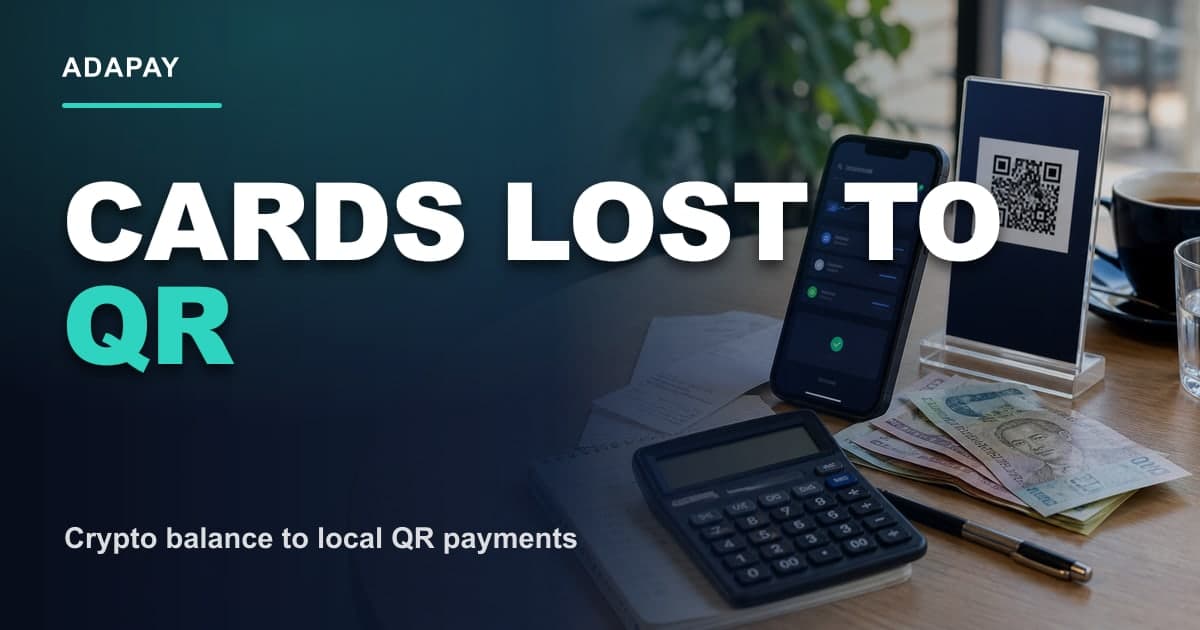
Why Southeast Asia skipped cards and went straight to QR
Understand why QR payments grew faster than cards across Southeast Asia and what that means for travelers, expats, and crypto-funded users.








Summarize content with
Open this guide in your preferred assistant and keep the payment decisions close.
 ChatGPT
 Perplexity
 Grok
Grok Gemini
What this guide solves
Travelers often arrive in Southeast Asia with a card-first worldview. Then they see local people paying with QR codes in places that never had card terminals. The region did not simply copy Western card adoption. It jumped into a cheaper, mobile-first payment habit.
This guide explains why that happened and what it means for crypto-native expats.
Quick answer
QR payments spread because they fit the merchant economy. A printed QR code is cheaper than card hardware, easier for small businesses, and natural in smartphone-first markets. Cards still matter for formal merchants, but QR often wins in daily life.
Why merchants liked QR
Card terminals require onboarding, hardware, settlement, fees, power, and support. A QR code can be printed and displayed almost anywhere. That difference matters for food stalls, small cafes, salons, clinics, repair shops, local services, and market vendors.
For many merchants, QR was not a downgrade from cards. It was the first digital payment method that matched their business.
Why consumers adopted it
Smartphone usage was already high. Local banks and wallets pushed scan-and-pay behavior. Governments and payment networks standardized national rails. Once friends, landlords, cafes, and small shops all used QR, the habit became normal.
The result is a payment culture where a hotel may accept your foreign card, but the noodle shop next door expects a scan.
What this means for travelers
| Old assumption | Southeast Asia reality |
|---|---|
| Cards are the most modern route | QR is often more normal for small merchants |
| Cashless means cardless | Cashless often means local scan |
| A foreign bank app should work everywhere | Local rails may be closed to foreign apps |
| Crypto is spendable if you have a card | QR-only merchants need another route |
Where ADAPAY fits
ADAPAY is built for this QR-first reality. Crypto holders already have value. The merchant already has a local payment method. The missing bridge is the route between wallet balance and local QR-style settlement where supported.
That is why ADAPAY’s message is not abstract crypto adoption. It is practical: scan local QR, pay from your wallet, keep living.
Final take
Southeast Asia did not skip financial sophistication. It skipped a card-heavy path that did not fit many small merchants. If you are traveling or living there, adapt your payment stack: cash for edges, card for formal commerce, and ADAPAY where supported for local QR payments funded from crypto.
Practical checklist
Before relying on this route in Southeast Asia, test it while the stakes are low. Try one small payment, verify the merchant name, confirm the currency, and save the confirmation screen. If the payment route depends on wallet balance, prepare that balance before you are standing at the counter.
For travelers, the best setup is boring in the best way: one local payment route that works, one card for formal merchants, enough cash for one bad-data moment, and a clear record for anything larger than a meal.
Common mistakes to avoid
- Assuming a visible QR code means every foreign app can pay it.
- Treating P2P as a checkout method instead of a planned liquidity tool.
- Moving tiny on-chain amounts repeatedly instead of preparing a spendable balance.
- Forgetting that rent, deposits, clinics, and repairs need proof.
- Going fully cashless before testing the local rail in a calm moment.
ADAPAY route in one sentence
Use ADAPAY where supported when your money starts in a crypto wallet but the real-world payment request is local, immediate, and QR-shaped.
Informational content only
This resource is general information, not financial, legal, tax, or investment advice. Local payment access, coverage, fees, and eligibility can change; verify terms with the relevant provider before relying on any route. ADAPAY's public financial service is not live.
Sources
These public references provide context for this guide and may be updated by the relevant organizations.