Cost guides
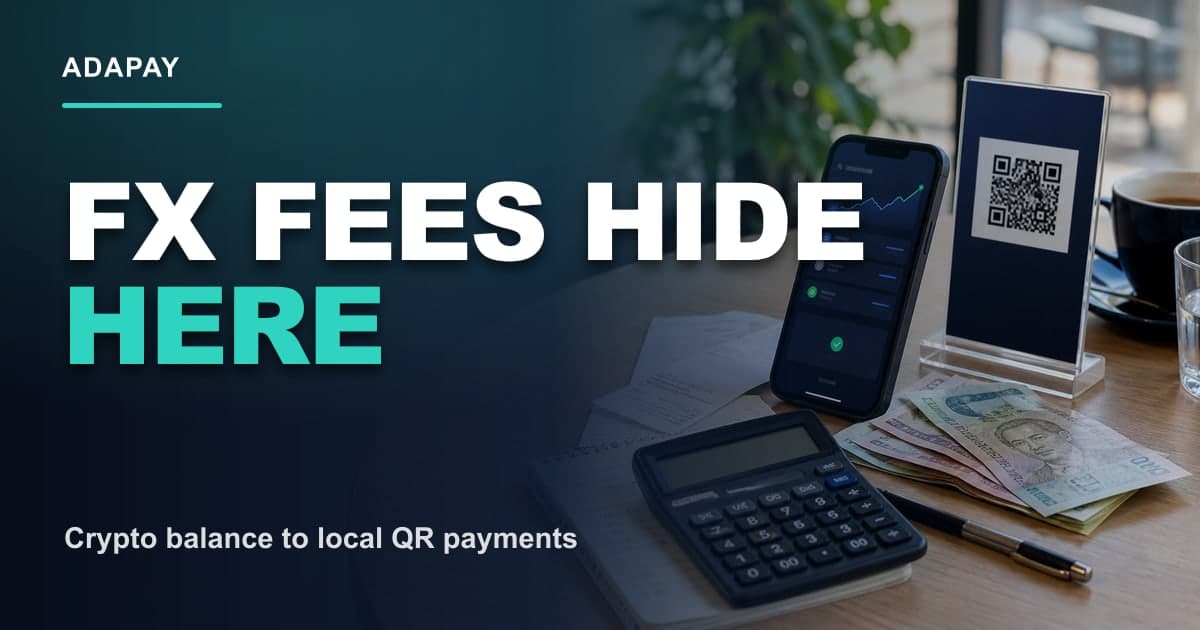
Hidden FX fees vs local QR payments: what expats should compare
Learn where travel payment costs hide across card FX, ATM withdrawals, P2P spreads, dynamic conversion, and local QR payments.







Summarize content with
Open this guide in your preferred assistant and keep the payment decisions close.
 ChatGPT
 Perplexity
 Grok
Grok Gemini
What this guide solves
Most travel payment costs do not appear as a polite invoice. They hide inside exchange rates, weekend card markups, ATM prompts, small withdrawal habits, P2P spreads, and last-minute conversions. That is why two payment routes can both say "low fee" while one quietly costs much more.
This guide gives expats and crypto-funded travelers a practical way to compare hidden FX fees against local QR payment routes.
Quick answer
The cheapest payment route is the one with the lowest total cost and the highest chance of working when the merchant is waiting. Do not compare only the advertised fee. Compare the whole chain:
- funding source;
- network or withdrawal fee;
- exchange rate;
- local settlement route;
- merchant acceptance;
- speed;
- receipt;
- fallback if the payment fails.
Where fees hide
| Cost layer | Where it appears | Why people miss it |
|---|---|---|
| Card FX spread | Foreign card purchases | The conversion is blended into the rate |
| Weekend markup | Some multi-currency cards and accounts | The fee depends on timing |
| Dynamic currency conversion | ATM or terminal prompts | The machine makes the bad option look convenient |
| ATM fixed fee | Cash withdrawals | Small withdrawals repeat the same fixed cost |
| P2P spread | Crypto cash-out trades | The rate looks normal until compared to a clean benchmark |
| Network fee | Stablecoin movement | Small payments can be distorted by fixed network costs |
| Local route fee | QR or assisted payment route | The final settlement path may add cost or limits |
Why local QR can be better
Local QR payments can reduce friction because they match the merchant’s preferred behavior. A small cafe, market stall, clinic, or landlord may already prefer a bank QR or wallet QR. When the payer has a route that can reach that local payment, the transaction can feel more native than card or cash.
The cost advantage is not automatic. It depends on how the QR payment is funded. A crypto-funded user should still compare spread, settlement time, and limits. The benefit is that the payment solves the actual merchant request instead of converting money into cash and hoping cash is accepted everywhere.
How to compare routes
For a real decision, model the same purchase three ways:
- Foreign card in local currency.
- ATM cash withdrawal, including fixed fees and exchange spread.
- Crypto-funded local QR route, including network, conversion, and route cost.
Then add reliability. A slightly cheaper route that fails at rent time is not cheaper. A slightly more expensive route that works reliably for daily QR payments may be better for actual life.
Where ADAPAY fits
ADAPAY helps crypto-native travelers evaluate the whole journey instead of only the crypto leg. The useful question is not "what is the chain fee?" It is "can my wallet balance become the local payment this merchant expects, at a cost and speed I understand?"
Use ADAPAY where supported for local QR-style payments. Keep a card for formal merchants. Keep cash for edge cases. Use calculators before large or repeat payments.
Final take
Hidden FX fees punish vague payment planning. Local QR payments reward preparation. If you are living from crypto or foreign balances in Southeast Asia, build a stack that makes costs visible: know your card terms, avoid bad ATM prompts, compare P2P rates, and use ADAPAY where supported to make wallet balance useful for local QR payments.
Practical checklist
Before relying on this route in Southeast Asia, test it while the stakes are low. Try one small payment, verify the merchant name, confirm the currency, and save the confirmation screen. If the payment route depends on wallet balance, prepare that balance before you are standing at the counter.
For travelers, the best setup is boring in the best way: one local payment route that works, one card for formal merchants, enough cash for one bad-data moment, and a clear record for anything larger than a meal.
Common mistakes to avoid
- Assuming a visible QR code means every foreign app can pay it.
- Treating P2P as a checkout method instead of a planned liquidity tool.
- Moving tiny on-chain amounts repeatedly instead of preparing a spendable balance.
- Forgetting that rent, deposits, clinics, and repairs need proof.
- Going fully cashless before testing the local rail in a calm moment.
ADAPAY route in one sentence
Use ADAPAY where supported when your money starts in a crypto wallet but the real-world payment request is local, immediate, and QR-shaped.
Informational content only
This resource is general information, not financial, legal, tax, or investment advice. Local payment access, coverage, fees, and eligibility can change; verify terms with the relevant provider before relying on any route. ADAPAY's public financial service is not live.
Sources
These public references provide context for this guide and may be updated by the relevant organizations.