Country payment guides
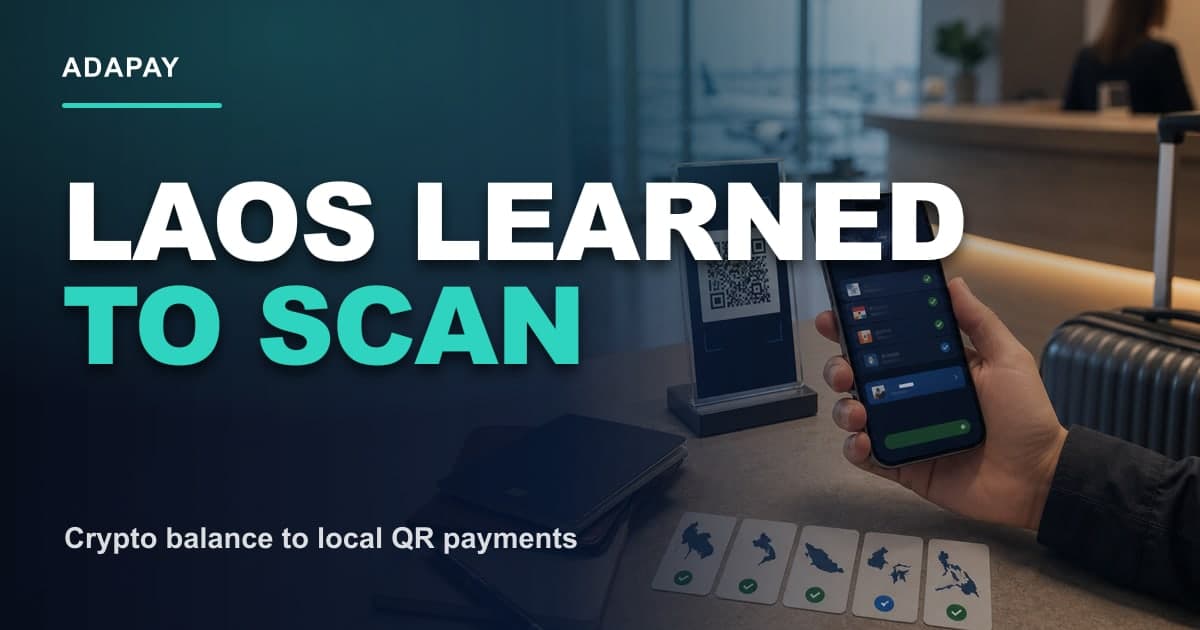
How Laos learned to scan: QR payments for travelers
Understand Laos QR payments, Lao QR, OnePay, LAPNet, EzyKip, LOCA Pay, cash backup, and ADAPAY planning for travelers.







Summarize content with
Open this guide in your preferred assistant and keep the payment decisions close.
 ChatGPT
 Perplexity
 Grok
Grok Gemini
What this guide solves
Laos used to be a country where travelers planned around cash and working ATMs. Now QR codes appear at noodle stalls, guesthouses, cafes, tuk-tuks, pharmacies, markets, and roadside counters.
This guide explains how Laos moved from cash-first to scan-ready, what foreigners still need to watch, and how ADAPAY users should prepare a practical payment stack.
Quick answer
Laos learned to scan because it built national QR infrastructure before card terminals became deeply entrenched. Lao QR, LaPASS, LAPNet, BCEL OnePay, and mobile wallets helped QR payments spread quickly, while cross-border QR links connected Laos with neighbors such as Cambodia, Thailand, Vietnam, and China.
From cash to a thin card layer
For much of the 2010s, Laos was still heavily cash-based. Card terminals were mostly found in hotels, city supermarkets, and formal merchants. Daily stalls, small restaurants, local transport, and guesthouses often expected kip.
Laos did build some card infrastructure. In 2015, the central bank worked with China UnionPay on domestic card systems, and UnionPay remains visible in Lao bank cards. But the country did not have a deep card-terminal habit to protect.
That mattered. When QR became cheap and standardized, merchants did not have to abandon an expensive card setup. Many could jump straight from cash to a printed code.
Lao QR, LaPASS, and LAPNet
The turning point was early 2020, when the Bank of the Lao PDR introduced the national Lao QR Code standard. Before a shared format, QR payments could be fragmented by bank or wallet. A national standard gave the market a common shape.
The plumbing behind it matters:
- The central bank had created a Payment Systems Department in 2018.
- LaPASS gave Laos a real-time settlement layer for instant movement between institutions.
- LAPNet became the national switch connecting banks and financial firms.
- BCEL OnePay helped push QR acceptance into daily merchant life.
- M-Money, run by Lao Telecom, became an important e-wallet in the market.
None of that is glamorous at the counter. But it is why a small vendor can show a QR code and receive confirmation without needing a card terminal.
Why adoption stuck
The Lao QR standard arrived just before COVID changed payment habits across the region. Handling cash became less attractive, and merchants had a reason to tape up a code quickly.
What is notable is that the habit remained. As travel returned, QR was no longer a novelty. In cities such as Vientiane and Luang Prabang, a traveler can now see QR codes in places that would have been cash-only a few years earlier.
Coverage is not uniform. Laos still has rural areas, low-signal pockets, small transport operators, and old-school vendors. But the direction is clear: phone payments are no longer only for banks and malls.
Cross-border QR links
Laos also moved quickly on cross-border QR.
The Cambodia link began in 2023, letting Cambodian users pay Lao merchants through familiar apps. In 2024, Laos and Thailand launched cross-border QR flows tied to PromptPay and Lao QR, important for countries joined by heavy border traffic and the Friendship Bridge. Vietnam connected VietQR with Laos around the start of 2025. China-linked payment rails also matter because Chinese visitors are a major tourism source.
By late 2025, the Laos-Cambodia QR connection had expanded further, and Vientiane had even seen cross-border digital-yuan QR activity. The pattern is bigger than one app: Laos is using QR as regional payment infrastructure.
Where foreigners get blocked
Most local QR flows still assume local access. A Lao bank account, Lao phone number, local identity flow, or eligible wallet setup may be required. That is where visitors run into the same problem they see elsewhere in Southeast Asia: the QR code is visible, but direct access is not.
There are local attempts to bridge the gap. BCEL's EzyKip tourist wallet and LOCA Pay can help some travelers top up and scan without a full local banking setup. They are useful options to review, but fees, limits, availability, and app behavior can vary.
Cards remain useful for hotels, larger tour operators, and formal merchants. Cash remains important outside cities.
ADAPAY payment planning for Laos
Before relying on ADAPAY in Laos, confirm current country and QR support in the app. If support is available to your account, prepare it while you have good internet and time to resolve verification.
Use this setup:
- Keep kip in small notes for rural areas, tuk-tuks, tips, temples, and weak-signal places.
- Keep a foreign card for hotels and larger bookings.
- Confirm ADAPAY Laos support, limits, and fees before your first market or transport payment.
- Test a low-value QR payment before depending on it for a long travel day.
- Check the recipient name and amount before confirming a scan.
- Keep the confirmation screen until the merchant acknowledges receipt.
Final take
Laos learned to scan because it built payment rails at the right moment: light card infrastructure, a national QR standard, real-time settlement, bank and wallet adoption, and regional QR links.
For travelers, the lesson is simple. Laos is no longer a cash-only country, but it is not a place to arrive unprepared either. ADAPAY users should come with a confirmed QR route, some small kip, and a backup card. Then the noodle stall, guesthouse, tuk-tuk, or cafe can be a normal payment moment instead of an ATM problem.
Informational content only
This resource is general information, not financial, legal, tax, or investment advice. Local payment access, coverage, fees, and eligibility can change; verify terms with the relevant provider before relying on any route. ADAPAY's public financial service is not live.
Sources
These public references provide context for this guide and may be updated by the relevant organizations.