Payment pain
No Binance P2P before dinner: how crypto expats can pay faster
Why crypto-native expats should stop treating P2P cash-out as the default before dinner, rent, rides, and local QR payments.







Summarize content with
Open this guide in your preferred assistant and keep the payment decisions close.
 ChatGPT
 Perplexity
 Grok
Grok Gemini
What this guide solves
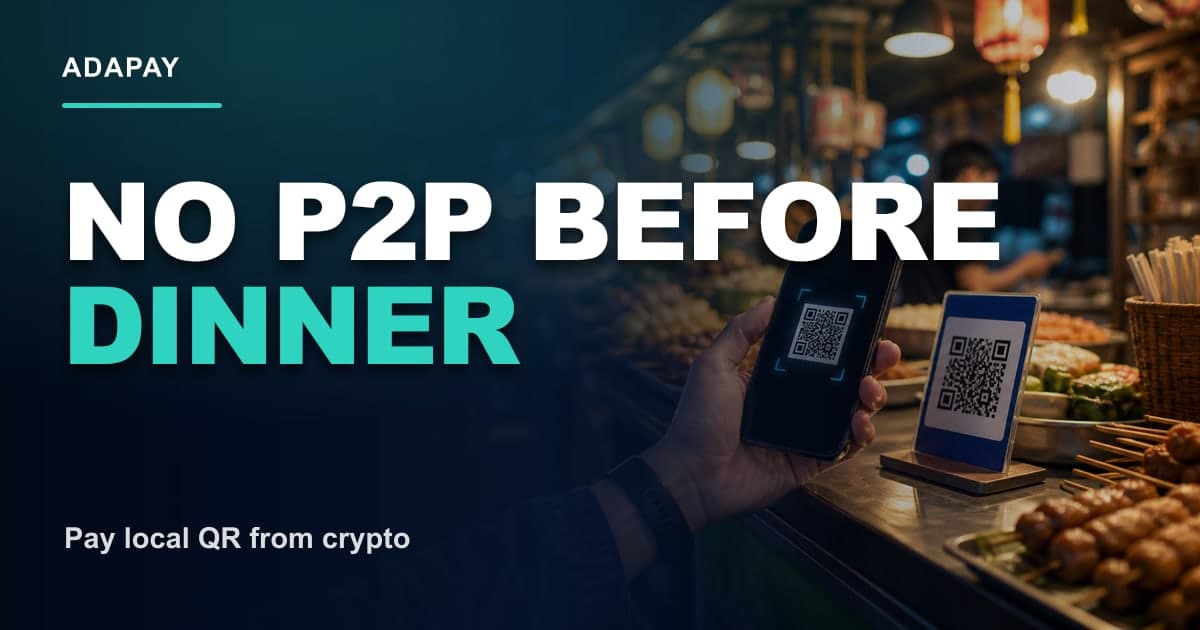
P2P works until it becomes your lifestyle. You want dinner. The restaurant wants a local QR payment. Your money is in crypto. Suddenly the evening becomes a mini operations desk: find a counterparty, check rate, transfer, wait, withdraw, pay.
This guide explains why crypto expats need a better default for daily local payments.
Quick answer
Use P2P for planned liquidity, not every ordinary purchase. If you are living in Southeast Asia from crypto, your payment stack should let wallet balance become local spending without forcing a fresh cash-out before dinner, rent, rides, clinics, and cafes.
Why P2P feels fine at first
P2P is flexible. It can solve a problem when banks are unavailable, cards are blocked, or local currency is needed. Many Russian-speaking expats and crypto-native travelers already know how to use it.
The problem is repetition. A tool for liquidity planning becomes a tax on daily life. Every payment requires attention. Every rate needs checking. Every counterparty introduces uncertainty.
Daily moments where P2P is the wrong tool
| Moment | Why P2P hurts |
|---|---|
| Dinner with friends | Nobody wants to wait for your cash-out |
| Rent deadline | Counterparty delay becomes real stress |
| Clinic payment | Proof and speed matter |
| Street market | The merchant expects cash or QR now |
| Late ride | Data, limits, and timing can fail |
| Coffee workday | Tiny payments should not need operations |
What a better stack looks like
Keep P2P as a backup or planned refill. Keep some cash. Keep a card. But add a local QR route where supported. The goal is to pay in the format the merchant already accepts while funding it from the balance you already hold.
For ADAPAY, this is the core use case: scan local QR, pay from wallet balance, keep living.
Final take
P2P is not the enemy. P2P as a daily checkout habit is the enemy. Crypto-native expats deserve a payment flow that matches normal life. ADAPAY is built to remove the awkward bank detour before the meal, the ride, the landlord, and the local QR code.
Practical checklist
Before relying on this route in Southeast Asia, test it while the stakes are low. Try one small payment, verify the merchant name, confirm the currency, and save the confirmation screen. If the payment route depends on wallet balance, prepare that balance before you are standing at the counter.
For russian expats, the best setup is boring in the best way: one local payment route that works, one card for formal merchants, enough cash for one bad-data moment, and a clear record for anything larger than a meal.
Common mistakes to avoid
- Assuming a visible QR code means every foreign app can pay it.
- Treating P2P as a checkout method instead of a planned liquidity tool.
- Moving tiny on-chain amounts repeatedly instead of preparing a spendable balance.
- Forgetting that rent, deposits, clinics, and repairs need proof.
- Going fully cashless before testing the local rail in a calm moment.
ADAPAY route in one sentence
Use ADAPAY where supported when your money starts in a crypto wallet but the real-world payment request is local, immediate, and QR-shaped.
Informational content only
This resource is general information, not financial, legal, tax, or investment advice. Local payment access, coverage, fees, and eligibility can change; verify terms with the relevant provider before relying on any route. ADAPAY's public financial service is not live.
Sources
These public references provide context for this guide and may be updated by the relevant organizations.