Digital nomad guides
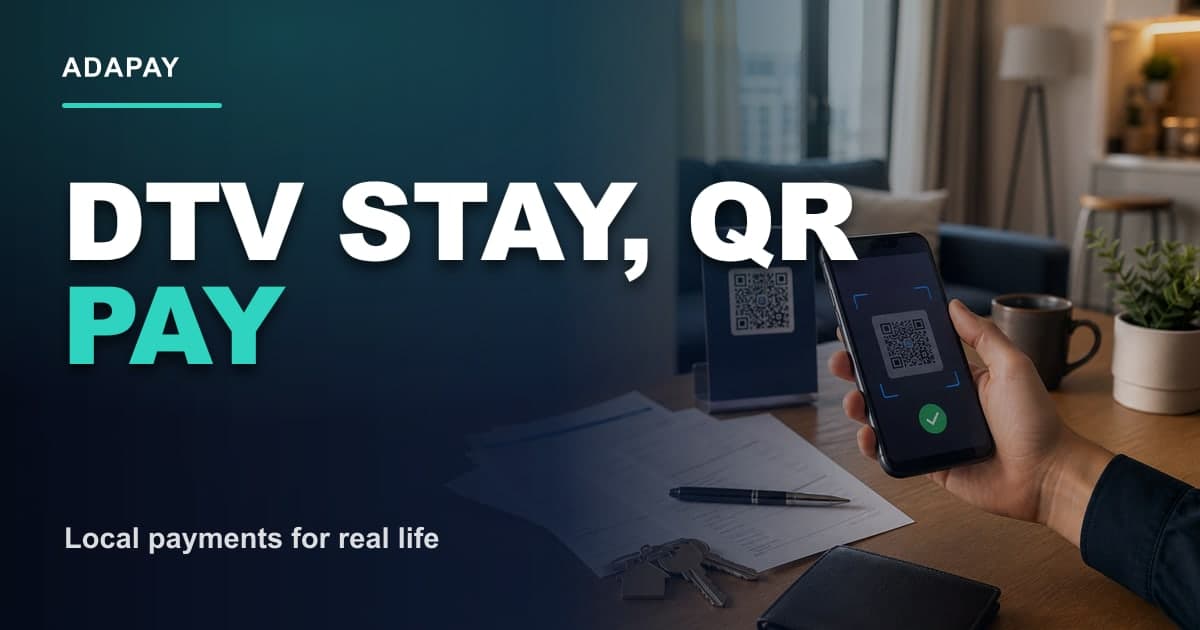
Thailand DTV visa payment solutions for long-term stays
Plan DTV finances with 500,000 THB proof, Thai bank hurdles, rent, utilities, PromptPay, cash, cards, ATMs, and ADAPAY.







Summarize content with
Open this guide in your preferred assistant and keep the payment decisions close.
 ChatGPT
 Perplexity
 Grok
Grok Gemini
What this guide solves
The Thailand DTV gives remote workers and long-stay travelers a much longer runway than a normal tourist trip, but money planning becomes more important once the stay stretches across rent cycles, utility bills, visa extensions, and repeated local purchases. The question is not only how to qualify for the visa. It is how to live in Thailand when the payment system around you expects Thai baht, PromptPay, bank transfers, cash, or local QR behavior.
This ADAPAY guide is for DTV applicants, digital nomads, and crypto holders who want a practical payment stack for the full stay, from application proof to daily spending.
Quick answer
Plan the DTV journey in two layers. First, prepare the formal money file: liquid funds, recent statements, work documentation, passport details, proof of residence, and any embassy-specific documents. Second, prepare the everyday payment file: how you will pay rent, groceries, cafes, clinics, coworking spaces, transport, and trips inside Thailand if a Thai bank account is slow or unavailable.
The practical stack is simple: keep proof funds clean, keep a home bank account active, carry some baht cash, keep a backup card, and use a local QR-ready route for Thai merchants that prefer PromptPay or bank QR payments. ADAPAY belongs in that final layer for crypto-funded users who need their balance to become a real-world Thai payment without rebuilding the process every week.
The DTV money file
Many DTV applicants prepare proof of at least 500,000 THB in liquid funds. In practice, that often means recent bank statements, a bank certificate, or equivalent documentation showing that the money is available, not locked in property or illiquid investments. Some applicants may also need contracts, salary slips, invoices, company documents, or freelance proof depending on the route they use.
Keep the money file boring and easy to review:
- Use statements that clearly show your name, bank, dates, currency, and final balance.
- Keep the account balance above the required threshold during the statement period.
- Avoid unexplained last-minute transfers when a steadier history is possible.
- Prepare passport, photos, current residence proof, and work documents in the format requested by the embassy or consulate.
- Save every submitted file in one folder, because extensions, re-entry planning, and future bank visits may ask for similar evidence.
This is not legal, tax, or immigration advice. The DTV is handled through official channels, and requirements can vary by nationality, embassy, and case history. Treat the embassy checklist as the final authority.
Thai bank accounts are not guaranteed
A Thai bank account makes life easier because it usually unlocks the local banking app and PromptPay-style QR payments. The catch is that opening one as a foreigner can be branch-dependent. Some banks have tightened onboarding for foreigners, and a DTV may not automatically satisfy every internal policy. A branch may ask for a passport, printed visa, Thai phone number, proof of address, and an in-person visit. Another branch may ask for more.
If you want to try, bring a clean document pack and budget time for friction. A landlord letter, condo contract, hotel residence proof, local phone number, and printed visa pages can help. A visa agent may know which branches are currently more open to long-stay foreigners, but you should still read the account terms, minimum balances, fees, and app limits before relying on the account.
The ADAPAY angle is different: do not make your whole stay depend on opening a Thai account in week one. Build a fallback for local QR payments before you need it.
Budgeting the long stay
Thailand can be inexpensive or surprisingly costly depending on city, island, season, and lifestyle. Chiang Mai, Bangkok, Phuket, Koh Samui, and smaller towns can feel like different budgets. Rent and utilities are the big recurring lines, followed by food, transport, coworking, visa runs or extensions, insurance, and weekend travel.
A simple monthly worksheet for a DTV stay should include:
| Category | Practical note |
|---|---|
| Rent | One-bedroom units can vary sharply by neighborhood, season, building, and lease length. |
| Utilities | Air conditioning can move the bill more than expected in hot months. |
| Food | Local meals are cheap; imported groceries, delivery, and western cafes raise the average fast. |
| Transport | BTS/MRT, Grab, motorbike rental, and intercity trips should be separate lines. |
| Visa admin | Keep cash for immigration visits, copies, photos, local transport, and unexpected document requests. |
| Payment costs | Track ATM fees, card surcharges, exchange spreads, transfer fees, and cash-out costs. |
Do not only ask whether Thailand is affordable. Ask which payment method will settle each line. Rent may be bank transfer. A condo office may accept QR. A clinic may accept card. A market may want cash. A coworking space may prefer QR. That mix is the real planning problem.
The daily payment stack
For DTV life, one payment method is too fragile. The stronger approach is a stack:
- Cash: keep 1,000 to 1,600 THB for markets, transport, tips, rural trips, and outages.
- Card: use it for hotels, malls, airlines, larger retailers, and emergencies, while watching foreign transaction fees and dynamic currency conversion.
- ATM plan: withdraw less often in larger, sensible amounts because Thai ATM fees and home-bank fees can add up.
- Exchange plan: compare reputable city exchange booths before using airport kiosks or random convenience options.
- Local QR route: prepare for PromptPay and Thai bank QR moments before a merchant asks you to scan.
- ADAPAY: use it as the crypto-funded bridge when the merchant wants a local payment and you do not want to run a fresh P2P trade.
For daily use, the key is not elegance. It is predictability. If you can pay a landlord, a food court, a clinic, a coworking desk, and a weekend tour without changing your whole money setup, you have a real long-stay payment system.
Getting paid from abroad
The DTV is designed for remote income connected to work outside Thailand. It is not permission to take local Thai employment or serve local Thai clients as though you had a Thai work permit. Keep contracts, invoices, platform statements, and bank records organized so your income story is clear.
For spending, many nomads keep income in a home bank, global fintech account, or crypto wallet, then convert only what they expect to use. If you hold stablecoins, decide in advance which portion is for local spending, which remains savings, and which stays untouched for visa proof. Mixing those buckets creates stress during extensions or financial reviews.
Avoid the common mistakes
The most expensive mistake is treating every transaction as a one-off improvisation. Small ATM fees, card spreads, bad exchange rates, and rushed P2P trades become meaningful over a five-year visa window.
Avoid these patterns:
- Using the closest ATM every time cash runs low.
- Paying in your home currency when the card terminal offers conversion.
- Assuming a Thai bank account will be opened immediately.
- Keeping no cash because Bangkok felt card-friendly for one day.
- Holding all spending money in a form that local merchants cannot accept.
- Letting rent, deposits, and utility payments depend on an untested transfer route.
ADAPAY checklist for DTV travelers
Before arrival:
- Prepare the DTV money file and keep visa funds separate from spending funds.
- Save your first accommodation, phone, and banking documents offline.
- Decide how much Thai baht you need for the first week.
- Keep a backup card and emergency cash separate from your daily wallet.
- Set up the route you will use when a merchant asks for a Thai QR payment.
After arrival:
- Test small payments before rent or deposits are due.
- Track real payment costs, not just sticker prices.
- Keep screenshots and receipts for large transfers.
- Review whether a Thai bank account is realistic for your branch, visa, and address situation.
- Keep ADAPAY ready for repeat QR-first moments where crypto balance needs to become local spending.
Final take
The Thailand DTV is a long-stay lifestyle product, but the payment reality is operational. You need proof of funds for the application, clean records for future admin, and a local payment stack for ordinary life.
ADAPAY does not replace immigration guidance, a Thai bank, or tax planning. It fills the daily gap for people whose money is available but not always in the form Thai merchants expect. For DTV nomads and crypto-funded expats, that can be the difference between constantly managing money and simply living in Thailand.
Informational content only
This resource is general information, not financial, legal, tax, or investment advice. Local payment access, coverage, fees, and eligibility can change; verify terms with the relevant provider before relying on any route. ADAPAY's public financial service is not live.
Sources
These public references provide context for this guide and may be updated by the relevant organizations.