QR payment guides
Why QR codes took over Argentina
Understand Argentina QR payments, Mercado Pago, MODO, Transferencias 3.0, cash, cards, and ADAPAY planning for foreigners.







Summarize content with
Open this guide in your preferred assistant and keep the payment decisions close.
 ChatGPT
 Perplexity
 Grok
Grok Gemini
What this guide solves
Argentina used to be famous among travelers for cash stacks, dollar talk, and awkward exchange math. Now a visitor can walk into a Buenos Aires feria, a kiosco, a pharmacy, a cafe, or a small food counter and see the same quiet instruction: scan the QR.
This guide explains why QR payments became normal in Argentina, why foreign cards still feel limited, and how ADAPAY users should prepare when local wallets expect resident-style access.
Quick answer
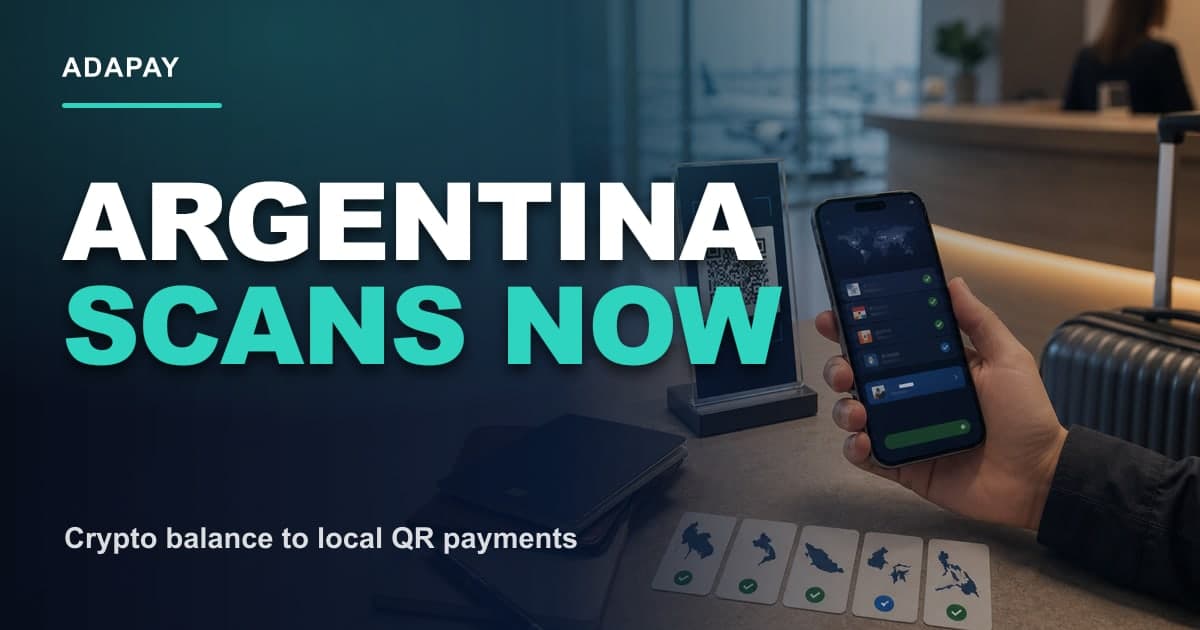
QR codes took over Argentina because inflation pushed money onto phones, merchants preferred low-cost transfers, and Transferencias 3.0 made QR payments interoperable across licensed wallets and bank apps. The result is a country where daily spending often feels phone-first even when visitors cannot easily open the local wallet accounts.
Inflation changed payment behavior
Argentina's inflation did more than raise prices. It changed how people think about holding pesos. When prices can move fast, cash becomes something to spend, not something to store comfortably.
That helped mobile wallets grow. A wallet balance can be easier to move, easier to pay from, and in some products easier to keep productive until checkout. Mercado Pago became especially visible because many Argentines already used it for everyday digital money movement.
Once the money lived on the phone, paying from the phone became natural.
Transferencias 3.0 built the rail
The more important plumbing was Transferencias 3.0, launched by Argentina's central bank in late 2020 and made fully interoperable by late 2021.
The practical rule was powerful: a QR generated in Argentina should work across licensed wallets and banking apps. A merchant did not need one code for Mercado Pago, one for MODO, and one for another bank. One interoperable code could accept payments from multiple apps.
That changed merchant behavior. If one laminated QR can cover the local wallet universe, putting it on the counter becomes easy. It also made QR feel less like a private app feature and more like national payment infrastructure.
One code, many apps
Argentina's QR layer is not just Mercado Pago, even though Mercado Pago is extremely visible. You may also see MODO, Cuenta DNI, Uala, and bank-linked apps. The merchant may not care which app the customer uses as long as the interoperable QR sends the payment to the right account.
That is the detail that made QR scale into small places. A kiosco, barber, bakery, market stall, rural merchant, or tiny restaurant can accept QR without committing to a card terminal or a single wallet brand.
By late 2024, the system had connected dozens of wallets into the shared QR network, and instant transfers had grown sharply year over year. By 2025, QR payment behavior was also moving into public transport in Buenos Aires, including subway, bus, and train flows. Once commuters use a rail every day, it stops feeling optional.
Why merchants push QR
Small merchants have a clear reason to like QR. Card processing can cost more than 3% per sale in some cases and may settle later. QR transfers are faster and can be much cheaper.
That is why a shop may offer a descuento for QR or cash and be less enthusiastic about a foreign card. The merchant is not being difficult. The local rail is cheaper, faster, and easier for them to confirm.
For foreigners, the same habit can be frustrating. The merchant has a simple payment method, but the visitor may not have the local identity or account needed to use it directly.
Where foreigners get blocked
Local wallets such as Mercado Pago, MODO, Cuenta DNI, and bank apps are built around Argentina's resident and banking system. Signup can involve DNI, tax details, an Argentine bank account, or local verification. A tourist or short-stay remote worker can hit a wall before the first payment.
Foreign cards still work in many formal places, but they are not a full daily-spending plan. Acceptance can be worse at small merchants, and repeated card use can bring FX spread or dynamic currency conversion. If a terminal asks whether to charge in your home currency or ARS, choose ARS.
Cash still matters, but it has its own friction: counting, carrying, changing large notes, managing safety, and dealing with rates.
Safety habit: verify the recipient
QR growth also creates a simple fraud risk: a fake code can be placed over a real one on a table, sign, meter, or counter.
Before confirming any QR payment, check the recipient name, amount, and currency. Keep the confirmation until the merchant acknowledges it. This is a small habit, but it prevents many messy conversations.
ADAPAY payment planning
For crypto-funded travelers, the Argentina problem is familiar: stablecoins are useful, but the merchant does not want a crypto lesson. They want a local payment confirmation.
Before relying on Argentina QR payments, confirm current support, limits, and fees inside ADAPAY. If a local QR route is available to you, prepare it before the payment moment.
A practical stack:
- Keep a foreign card for hotels, flights, larger merchants, and formal bookings.
- Keep some pesos for cash-first stalls, tips, and places with poor connectivity.
- Confirm any ADAPAY local route before the first market, taxi, tour, or food run.
- Choose ARS on card terminals when the alternative is home-currency conversion.
- Check recipient details before confirming QR payments.
- Keep receipts and screenshots for deposits, transport, and higher-value purchases.
Final take
Argentina did not become QR-heavy because one app got popular by accident. Inflation pushed money onto phones, Transferencias 3.0 made QR codes interoperable, and merchants learned that instant transfers fit daily commerce better than card friction.
For foreigners, the lesson is clear: Argentina may look card-friendly in formal places, but ordinary spending often expects local QR behavior. ADAPAY's role is to help crypto-funded users prepare for that local format, with cash and cards kept as backups rather than the whole plan.
Informational content only
This resource is general information, not financial, legal, tax, or investment advice. Local payment access, coverage, fees, and eligibility can change; verify terms with the relevant provider before relying on any route. ADAPAY's public financial service is not live.
Sources
These public references provide context for this guide and may be updated by the relevant organizations.